
November 28, 2022
Guide to Investigating Organized Crime in the Golden Triangle
Global Investigative Journalism Network
This guide was written by Bertil Lintner and edited by Nikolia Apostolou, David E. Kaplan, Reed Richardson, and Alexa Van Sickle. Illustrations are by Nodjadong Boonprasert. Smaranda Tolosano coordinated the translations.
To read the Introduction start here.
Click here for Burmese version.
On GIJN’s YouTube Channel, you can also watch a webinar on investigating organized crime in the Golden Triangle, which was held on Dec. 1, 2022.
This guide was possible due to the invaluable support of the Global Initiative Against Transnational Organized Crime (GI-TOC), an independent civil-society organization dedicated to seeking new and innovative strategies and responses to organized crime.
INTRODUCTION
There are three major myths about the Golden Triangle, where the borders of Myanmar, Thailand, and Laos intersect. The first concerns the name itself, which suggests that it has something to do with gold — perhaps because it has been used as payment for the drugs frequently exported from the area. The second is that Southeast Asia’s opium trade has deep historical roots and that poppies have been grown there for centuries. The third is that there is a battle going on between “bad guys” (traffickers and their criminal associates) and “good guys” (international and local law enforcement agencies doing their best to stop the trade and arrest the criminals who are behind it). On the ground, however, these distinctions aren’t clear-cut.
GIJN’s guide to investigating organized crime in the Golden Triangle covers an array of topics. Click here to see the full table of contents.
Contrary to popular belief, the Golden Triangle is not an old name for Southeast Asia’s opium growing region. It first appeared in print as recently as July 24, 1971 in a cover story titled “A Wonderland of Opium” for the now defunct Asia-wide weekly magazine the Far Eastern Economic Review. It was written by T.D. Allman, an American author, historian, and journalist, quoting then-US Assistant Secretary of State Marshall Green, who was saying that most opium was not grown in China, as Washington once claimed, but in a “golden triangle” stretching from northeastern Myanmar to northern Thailand and northwestern Laos. At the time, Washington was trying to win favor with Beijing and — coincident with Green’s statement and Allman’s article — it was announced that Nixon would visit China the following month.
Whatever the reason behind the term, it soon stuck, most likely because it captured the imagination of the public and evoked the lawless nature of the opium trade. Within a few years, the Golden Triangle — now with capital “G” and “T” — came to symbolize all of Southeast Asia’s narcotics-related problems. The name also caught on in Chinese (translated as jin sanjiao) and in Thai (samliam thongkham). It is easy to understand why. Only two currencies have remained constant in the area: narcotics and gold. In the past, heavily guarded mule convoys would take raw opium from the poppy fields in northern Myanmar to the border town of Tachilek opposite Mae Sai in Thailand, where most of it was sold to buyers from Thailand, Laos, and beyond, often in exchange for bars of pure gold. So gold was used to pay for opium, but that was not how and why the area got its name.
Since the Golden Triangle has no fixed borders and spans several countries, it is impossible to determine its exact size, but 200,000 square kilometers (about 77,220 square miles), or slightly smaller than the United Kingdom, would be a fair estimate. It is a rugged, mountainous area, and it is sparsely populated. No more than six to seven million people live there and they belong to ethnic minorities, mostly hill tribes but also some valley dwellers. The Myanmar portion of the Golden Triangle is by far the largest and the poorest, and that is also where most opium has always been grown. The Thai sector is very well-developed, now mostly urbanized, and no longer produces any opium. Laos is still an opium producer, but not to the same extent as before.

Approximate map of the “Golden Triangle,” encompassing the border regions of Myanmar, Thailand, and Laos. Image: Shutterstock
The hill peoples who grow opium in Myanmar today, or until quite recently, grew it in Thailand and Laos, live at an altitude where paddy cultivation is not practicable, which means that they have to depend on a cash crop to buy rice and other commodities from the lowlands. But contrary to popular belief, the opium poppy has not always been a major cash crop in the Golden Triangle, nor has the sale and consumption of opium always been illegal. Prior to World War II, all countries in Southeast Asia had government-controlled opium monopolies, not unlike tobacco and liquor monopolies today.
The British fought two Opium Wars against China in the 19th century, 1839-1842 and 1856-1860, which led to the acquisition of Hong Kong and the opening up of the Chinese market for opium from India. The British East India Company controlled vast poppy fields in Bengal — the eastern part of the Indian subcontinent, which today generally corresponds to Bangladesh and the Indian province of West Bengal — and other parts of the colony, as well as opium warehouses in Calcutta (now Kolkata), Bombay (now Mumbai), and other major cities in colonial India. In Burma, small quantities of opium — before World War II perhaps 30 tons or so per year — were grown in the highlands of the Shan States (parts of which now form the Myanmar sector of the Golden Triangle), and opium taxes produced some income for the Shan princes. The trade was strictly controlled by the colonial authorities under the 1910 Opium Act and later by the 1938 Opium Rules.
Siam (now Thailand) was never a European colony, but that did not mean that it escaped the scourge of the opium trade that had followed foreign rule in neighboring countries. In 1852, Siam’s King Mongkut (Rama IV), who had tried to ban the use of opium, bowed to British pressure and began importing vast quantities of the drug from India. Mongkut established a royal opium franchise which was “farmed out” to local entrepreneurs, mostly wealthy Chinese traders. Opium, lottery, gambling, and alcohol permits were up for grabs. By the end of the 19th century, taxes on these monopolies provided between 40 and 50 percent of Siam’s government revenue.
At an early stage, the French also turned to opium to finance their conquest of Indochina. Opium was imported to that region from Afghanistan and India, and the various French drug interests were consolidated under a single government-administered opium monopoly, a powerful agency called the Régie de l’opium. Profits soared and trade was brisk. By 1900, tax on opium accounted for more than half of all revenues in French Indochina. In 1930, the territory had 3,500 licensed opium dens, or one for every 1,500 adult males. The Dutch in the East Indies (now Indonesia) had a similar system and imported opium from Turkey and Persia (now Iran).

Model of opium den, Hall of Opium Museum, Ban Sop Ruak, Thailand. Image: Shutterstock
World War II not only altered the political map of Asia — India’s independence in 1947 eventually led to the end of colonial rule in the world’s most populous continent — but also had a dramatic impact on Southeast Asia’s opium trade. The war had meant that the sea routes from India and West Asia had become insecure, which prompted the French to encourage poppy cultivation in the highlands of northwestern Tonkin (now northwestern Vietnam) and Laos. Thailand, which had never been a major opium producer, also saw an increase in poppy cultivation in the north.
The old colonial opium monopolies were gradually abandoned. India continued its production of opium, but on a much-diminished scale and purely to produce morphine and other medicines for pharmaceutical use. Other uses were criminalized — at least officially. Corruption remained a major issue and domestic problems led to a dramatic increase in production, especially in Myanmar. The turning point was the invasion of parts of northern Myanmar by the Kuomintang (KMT), the Chinese Nationalists. Defeated in 1949 in China’s civil war, Nationalist Chinese forces retreated into remote areas of northeastern Myanmar, in which they set up a string of secret bases. The aim was to reconquer China from Mao Zedong’s Communists. The KMT’s involvement in the opium trade was openly explained by one of its most famous generals, Duan Xiwen (Tuan Shi-wen): “We have to continue to fight the evil of communism and to fight you must have an army, and an army must have guns, and to buy guns you must have money. In these mountains, the only money is opium.”
The Golden Triangle remains one of the world’s great centers for all kinds of illegal activities.
This statement prophetically described why so many other armed groups in the Shan States — resistance forces who took up arms against the central authorities in the late 1950s, as well as the Myanmar government’s own army and local militias — became involved in the complex politics of the Golden Triangle drug trade. The KMT persuaded the hill-tribe farmers to grow more opium and then the group introduced a hefty opium tax that forced local farmers to produce even more to make ends meet. By the mid-1950s, opium production in the Myanmar sector of the Golden Triangle had shot up 10-20 times, to an annual yield of 300 to 600 tons. The war in northern Myanmar also meant that it was too risky to bring traditional cash crops like tea or tobacco to lowland markets. Instead, it was now safer to grow opium because the traders would come to the villages and buy the raw product there.
Myanmar’s economy also collapsed following a military coup in 1962 and the introduction of a disastrous policy called the Burmese Way to Socialism. In order to fight Shan and other insurgents, Myanmar’s military ruler General Ne Win established local home guard units in 1963 called Ka Kwe Ye (KKY, “defense” in the Myanmar language). They were given the right to use all government-controlled roads and towns in Shan State for opium smuggling in exchange for fighting the rebels. By allowing them to trade in opium, the Myanmar government hoped that the KKY militias would be self-supporting; there was hardly any money in the central coffer in Yangon to support a sustained counter-insurgency campaign at this stage. Many KKY commanders became rich on the deal. The most infamous of the Golden Triangle’s drug lords, Lo Hsing-han (Luo Xinghan) and Zhang Qifu (Chang Chifu) — the latter commonly known by his alias Khun Sa — began their respective careers as government-allied KKY commanders: Lo in the opium-growing area of Kokang, and Khun Sa on the opium mountain of Loi Maw near the Myanmar army’s garrison town of Tang-yan.

Map showing illicit crop cultivation in northeast Myanmar and northern Laos in the Golden Triangle region, circa 2016. Image: UNODC
Today, the Golden Triangle’s opium production has declined considerably as the demand for opium and its derivative, heroin, has declined in the region and worldwide. But that has affected only the poor hill-tribe farmers who grew the poppies and have lost their incomes; the drug lords have instead turned to the production of methamphetamines (referred to locally as ya ba, Thai for “madness medicine”) and other synthetic drugs, for which only chemicals are needed and there is a new and ready market. The general lawlessness of, in particular, the Myanmar sector of the Golden Triangle has also made it a center for other illegal activities, such as people smuggling, trade in wildlife, rare earth mining, and antiquities trafficking. Guns, some rather sophisticated, are produced in factories and workshops in the Golden Triangle and sold to rebels as well as criminals in Southeast and South Asia. At least 20 casinos have also been built in northern Laos and along Myanmar’s borders with Thailand, which serve as vehicles for money laundering.
In other words, the Golden Triangle remains one of the world’s great centers for all kinds of illegal activities. The hidden, black economy in the area and its spin-offs run into billions of US dollars annually.
In the Golden Triangle there is, supposedly, a “war on drugs,” a term popularized by the media after a press conference given by then-President Richard Nixon in June 1971 during which he declared drug abuse “public enemy number one.” And that war is still being fought.
But the war on drugs in this region is not as clear-cut as international agencies want the outside world to believe. Myanmar’s ethnic insurgency as well as the government’s counter-insurgency campaigns have always been closely connected with the narcotics trade. The KKY were abolished in 1973, but new, government-recognized militias called pyi thu sit (“people’s militia”) have taken their place, running a wide variety of officially sanctioned criminal activities. Rampant corruption is also widespread within law enforcement agencies in Myanmar, Thailand, and Laos — and it is precisely with those local entities that international law enforcement groups and United Nations agencies have to cooperate. Therefore, official complicity in the trade is rarely mentioned in reports compiled by foreign law enforcement agencies and never by the United Nations Office for Drugs and Crime (UNODC).
It is important to study the historical background when writing about the trade in drugs and other commodities in the Golden Triangle.
Furthermore, the pioneers in the Golden Triangle opium trade, the KMT, operated closely with US, Thai, and Taiwanese spy agencies, which turned a blind eye to the KMT’s officially illicit activities as long as they proved to be useful intelligence assets. Today — and for the same reasons — China has cordial relations with Golden Triangle drug traffickers. The final outcome of the “war on drugs” is that those who get caught are mostly couriers who carry the drugs from one place to another — and who can be easily replaced. Big traders seldom get caught or, if they are, they manage to strike deals with governments. Lo Hsing-han and Khun Sa ended their days as wealthy businessmen, living in luxury in the old capital Yangon.
For decades, the Golden Triangle has drawn journalists from around the world, attracted by the region’s illicit markets, its rich history, and fascinating cultures. Through the lens of a crime reporter, the region offers an extraordinary array of stories. But journalists should approach such stories with a healthy degree of skepticism, as facts on underworld markets can be hard to come by. A few suggestions to keep in mind:
It is important to study the historical background when writing about the trade in drugs and other commodities in the Golden Triangle. It is never as clear-cut as many may believe. It involves many different actors, legal as well as illegal and some in-between, and journalists should proceed with utmost care, objectivity and without sensationalizing the issues. Finally, many of the local players are seen as perfectly respectable businesspeople or government officials in their home countries, who could be litigious if their reputation is sullied by an exposé. As a result, legal risks must be taken into consideration, and any major story should be vetted by lawyers prior to publication.
Chapter 1 — Drug Trafficking
The Myanmar sector of the Golden Triangle is where most drugs in the region are produced, sold locally, and smuggled out to international markets. Thailand has ceased to be an opium-growing country but still plays an important role as a market for drugs, a center for money laundering, and a conduit for narcotics destined for other parts of the world. Laos has also ceased to be a major opium-producing country, but there are methamphetamine laboratories in remote parts of the country. Drugs produced in Myanmar are often funneled through Laos to Thailand and Vietnam, and money derived from the drug trade is laundered in casinos in the northern part of Myanmar and Laos.
How it Works
The drug trade on the main, Myanmar sector of the Golden Triangle, as well as other unofficial commercial activities in the area, involves many different players, and the hierarchy of their roles can be described as follows:
The farmers who grow the poppies earn a pittance for months of laborious work. They are mostly hill-tribe peoples, such as Kachin, Lahu, Wa, Lisu, Palaung, and Akha, but there are also poor, ethnic Chinese peasants from Kokang and other mountainous areas in Myanmar’s Shan State and, to a lesser extent, Kachin State. Despite living at subsistence level, they still have to pay “taxes” to various rebel groups and Myanmar Army-affiliated militias claiming their areas, as well as bribes to government officials who are supposed to enforce the laws against drug cultivation.
Intelligence agencies from various countries have a long history of using drug traffickers as assets.The merchants who buy the opium from the farmers and pay tax to the rebels and the militias are respected local businessmen who live quite openly in government-controlled market towns. They send their agents to the hills to purchase harvested raw opium, and then use various armed bands to transport the drugs to the refineries along the Thai border. The front for a middleman operation like this could be a supermarket, a chain of petrol stations, or an ordinary trading house, doubling as a wholesaler of legitimate consumer goods. These merchants can be based in Myanmar, Thailand, Laos, or China. The methamphetamine trade has produced a different kind of investors, but they are also using perfectly legitimate businesses to conceal their involvement in the narcotics business.
Myanmar’s ethnic rebels and militias, who control and operate in the poppy growing areas, collect so-called tax from the farmers and the merchants. They also provide protection, for a fee, for laboratories where raw opium is refined into heroin as well as, increasingly, production facilities for methamphetamine and other synthetic drugs. The actual owners of those laboratories are usually outside traffickers who also hire professional chemists to refine the drugs. Local ethnic rebels have political agendas and most of them are not involved in the drug trade or play only minor roles in it. Government-affiliated militias, however, are in it solely for the money. Like the old Ka Kwe Ye, or KKY (literally “defense”), government-recognized militias which were set up in the late 1960s to fight anti-government rebels and then disbanded in 1973, they are allowed to trade in narcotics in exchange for fighting the ethnic rebels.
Intelligence agencies from various countries have a long history of using drug traffickers as assets, but that does not, as claimed by some writers, mean that those agencies are using drug money to finance the murkier side of their activities. During the Indochina War in the 1960s and 1970s, the Americans used the Chinese Kuomintang (Nationalist Chinese forces that had retreated into northeastern Myanmar after their defeat in the Chinese civil war in 1949) to collect intelligence in northern Myanmar, northern Laos, and across the border in southern China. That relationship no longer exists, but Thai intelligence agencies do maintain links to various actors inside the Myanmar sector of the Golden Triangle. Increasingly, China’s security services are also involved, using armed groups in Myanmar for intelligence gathering and as leverage to get influence in internal Myanmar affairs.
Drug syndicates based in Thailand, China, and elsewhere provide financial support and also supply chemists to the heroin refineries and methamphetamine laboratories along Myanmar’s borders with Thailand and China. These syndicates also manage the regional and international distribution of the drugs. They are not, as some writers believe, offshoots of or the same as Hong Kong- and Macau-based Triads. The “kingpin” theory, or the belief that there are a small number of drug dealers who control most of the trade, which has been promoted among others by the US Drug Enforcement Administration (DEA) in Southeast Asia and elsewhere, is more Hollywood than reality. As Ko-lin Chin, a leading authority on the Golden Triangle drug trade has pointed out, the drug networks “are horizontally structured, fluid, and opportunistic.” The Triads may sell drugs in their respective territories, but they don’t run the trade as such.
The couriers are perhaps the most visible links in the narcotics chain, since they are the ones most frequently caught and exposed by the media. A courier, or a “mule,” could be anyone who was hired by the syndicates to carry drugs from one place to another. These couriers are often labeled by the media as well as law enforcement agencies as “drug traffickers,” but the use of this term for low-level actors often deflects attention away from the much more powerful syndicates, which effectively operate above the law.
The addicts, the consumers of the drugs, and their families are among the most impacted victims of the drug business along with the impoverished farmers who grow the poppies. Although most of the narcotics produced in the Golden Triangle are destined for foreign markets, it is often forgotten that drug abuse still is widespread in tribal villages in the Golden Triangle, causing enormous social problems locally.
The military takeover in Myanmar in February 2021 has not changed the way in which the drug trade works or the way in which it is done. The basic hierarchy remains the same.
Tips and Tools
It is of utmost importance to build up a network of trusted, on-the-ground sources such as local journalists, foreign and indigenous NGO workers, teachers, and other community-based workers, and even local businessmen who may be willing to share information. But remember that they live and work in the region, so if they ask for anonymity, it must be respected. Information provided by official sources can also be used, but should be treated with utmost care because what they tell journalists seldom reflects the actual situation inside the Golden Triangle criminal netherworld. But these officials are among the best options for on-the-record quotes, because few of the other sources would be willing to talk publicly using their own names.
There are a few online tools and resources about the Golden Triangle drug trade, but not all of them are reliable and should be cross-checked with knowledgeable local sources.
Reports of the United Nations Office on Drugs and Crime (UNODC) are available online.
So are the US Drug Enforcement Administration’s reports. The US State Department has a specific page for Myanmar (Burma). The US Embassy in Burma also has information on drug enforcement efforts in that country.
More reliable information is available on the website of the Shan Herald Agency for News (SHAN), an independent NGO based in Chiang Mai, northern Thailand. SHAN follows events inside the Golden Triangle and has produced a number of reports on the drug trade.
The Transnational Institute (TNI) in the Netherlands is also an excellent source of independent reporting and alternative views on the Golden Triangle drug trade.
Chao Tzang Yawnghwe was an ethnic Shan (he died in 2004) — his father, Sao Shwe Thaike, served as Myanmar’s first president (1948-1952) — who wrote extensively about his homeland, Myanmar’s ethnic minorities, and related issues such as the politics of drugs.
Other Useful Literature
Official reports from the UN are often unreliable because they are based on data collected by host governments, and in Myanmar especially, that is a major problem.
Although it was written half-a-century ago, Alfred McCoy’s groundbreaking “The Politics of Heroin in Southeast Asia” is still a must-read for anyone who wants to cover the Golden Triangle. McCoy was the first to put the drug trade in a political context and not treat it as primarily a law-and-order problem. The original 1972 edition was updated in 1991 and 2003.
“The Secret Army: Chiang Kai-shek and the Drug Warlords of the Golden Triangle” by Richard Gibson and Wenhua Chen (2011) also gives a comprehensive background to the growth of the Golden Triangle drug trade.
Other literature includes Bertil Lintner’s “Burma in Revolt: Opium and Insurgency Since 1948” (1994, 1999, 2003, and 2011), “Blood Brothers: Crime, Business and Politics in Asia” (2002, US edition 2003), “Merchants of Madness: The Methamphetamine Explosion in the Golden Triangle” (2009), “The Wa of Myanmar and China’s Quest for Global Dominance” (2021), and “Cross-Border Drug Trade in the Golden Triangle” (1991).
Ko-lin Chin’s “The Golden Triangle: Inside Southeast Asia’s Drug Trade” (2009) and (with Sheldon X. Zhang) “The Chinese Heroin Trade: Cross-Border Drug Trafficking in Southeast Asia and Beyond” (2015) are excellent, scholarly studies of the drug trade and how it works.
Pierre-Arnaud Chouvy and Joel Meissonnier’s “Yaba: Production, Traffic and Consumption of Methamphetamines” (2002) and Pierre-Arnaud Chouvy’s “Opium: Uncovering the Politics of the Poppy” (2009) are also worth reading as is Pierre-Arnaud Chouvy (ed.) “An Atlas of Trafficking in Southeast Asia: The Illegal Trade in Arms, Drugs, People, Counterfeit Goods and Natural Resources in Mainland Southeast Asia” (2013).
Official reports from the UN are often unreliable because they are based on data collected by host governments, and in Myanmar especially, that is a major problem. In 2019, the UNODC released a report claiming that “the highest density of poppy cultivation took place [the year before] in areas under the control of…the Kachin Independence Army (KIA)”, referring to a politically motivated, anti-government rebel group active in Myanmar’s Kachin State. In fact, as shown on the UNODC’s own maps accompanying the report, poppy cultivation in Kachin State was confined to areas controlled by a local militia under the command of the Myanmar Army. The report prompted the Transnational Institute (TNI), an independent Netherlands-based NGO, to issue a statement criticizing the UNODC and calling its report a “distortion of reality.”
The US DEA is somewhat more reliable than the UNODC, but its reports are also often misleading. A typical example: in early 2022, the DEA claimed that one of its undercover agents had secured evidence leading to the arrest of a “leader of a Yakuza organized crime gang,” as well as three Thais who claimed to have military backgrounds, as part of an alleged plot to sell US-made man-portable air-defense systems (MANPADS) to three ethnic rebel groups in Myanmar. Part of the payment was to be in drugs. But investigations by journalists showed that none of the three groups had ever heard of the deal and that the purported “Yakuza boss” was actually a low-level swindler living in a modest apartment in a Tokyo suburb. In the end, all that the DEA appears to have ended up with is the arrest of a talkative Japanese fraudster — and three Thai conmen no one inside Myanmar seems to have heard of. Nevertheless, the DEA touted it as a major victory in the “war on drugs.”
Case Studies
Drugs, Guns And Four Stories From The Northeast, Outlook India (2020)
Drugs from the Golden Triangle are being smuggled not only to Southeast Asia and beyond but also to nearby India. The northeastern Indian states of Arunachal Pradesh, Nagaland, Manipur, and Mizoram share their borders with Myanmar, and drug addiction is a major problem in all those states. First, it was opium and heroin, and now different types of methamphetamines and other synthetic drugs. On September 25, 2020, the Indian weekly Outlook published an investigative piece on the drug problem in the northeast. The report is based on interviews with drug addicts, activists, and local law enforcement officials (most of them anonymous, but the article is well-documented and credible). The author of the article traces the history of the drug trade and drug addiction in India’s northeast and outlines the involvement of local rebel groups as well as corrupt military officers and government officials in the region. It also lists major trafficking routes into India. The strength of the investigation is that it was written by a local (Manipur) peace activist and, therefore, also addresses stereotypes when it comes to perceptions of the tribal areas of the northeastern states in the rest of India. If you wish to cover the issue, don’t forget to cover illicit opium production in remote areas of Arunachal Pradesh, which, several sources claim, is increasing (although the exact volume of opium being produced illegally is not known). Most of it appears to be consumed locally, while some is transported to other parts of India.
The Real Driving Forces Behind Myanmar’s Opium Trade, Asia Times (2019)
There is no doubt that Myanmar remains the largest producer of opium, its derivative heroin, and various other synthetic drugs in the Golden Triangle. But changes are occurring and recent developments in Myanmar’s drug business were investigated in an article published by Asia Times on April 2, 2019. The investigative report pointed out that for the past few decades, China has been the main market for drugs from Myanmar. The author of the article managed to detect changing consumption patterns in China by looking at price structures. As the Chinese middle class is growing and becoming more “modern,” heroin is no longer the drug of choice. Chinese drug users are turning to party drugs, locally produced “ice” (methamphetamine) and fentanyl, and even cocaine imported from South America. Consequently, Myanmar’s opium farmers are suffering and no viable alternative has been offered to them (they live in war zones where development projects are few and far between). The only exception to this downward trend is in Kachin State, where militias allied with the Myanmar Army are propping up the cultivation of opium as well as the production of heroin. Relatedly, heroin addiction is widespread in Kachin State, especially among young people, and the rising number of addicts there shows that drug addiction has become a major local social problem, especially in the war-torn areas where Myanmar’s ethnic minorities live.
Merchants of Madness: The Methamphetamine Explosion in the Golden Triangle by Bertil Lintner and Michael Black (2009)
Laos is another underreported link in the Golden Triangle drug trade and, since the end of the Indochina War in 1975, it has seldom appeared in stories about the regional narcotics business. One reason is that significant quantities of opium are no longer grown there and little is known about the local production of methamphetamine. But, in October 2021, Lao law enforcement officials seized a truck carrying 55 million methamphetamine tablets and 1.5 tons of crystal methamphetamine — a distilled, more potent form of the drug. The bust came shortly after Lao police had seized 16 million amphetamine tablets in two separate operations in the same area — Bokeo in the Lao sector of the Golden Triangle — over a one-week period. The seizure was widely reported in the media in Southeast Asia, but few actually looked into the origin of the drugs. An investigative journalist would have done precisely that and found out that the drugs were produced in Myanmar and the route through Laos and on to markets in Thailand and Vietnam was chosen because it was assumed that Lao law enforcement agencies would be less competent and vigilant than their counterparts in neighboring countries. In September 2022, Laos made another huge drug haul: 33 million methamphetamine tablets were seized near Kings Roman, a casino complex in the Lao sector of the Golden Triangle.
Chapter 2 — Official Complicity in Drug Trafficking
Official complicity in the Golden Triangle drug business comes in two different forms: corruption and politically motivated alliances between the gangs involved in the trade and the militaries of governments in the region. Corruption is fairly straightforward and easy to understand and explain. There is no accurate estimate of how much the Golden Triangle drug trade and related criminal activities generate annually, but it is believed to be in the billions of dollars. Given the vast amounts of money involved in the various businesses and the low salaries of local law enforcement personnel and government officials in, for instance, northern Thailand, it is hardly surprising that many of them succumb to the temptation to accept bribes. A high-ranking Thai military officer with integrity once told me: “We can send the best and most honest officer to the north, but after six months we have to move him out. The problem is simple. The traffickers hold a gun in one hand and a bag of money in the other. He has a choice: a bullet in the head or accepting the money and turning a blind eye to the traffic.”
Drug traffickers have time and again proven to be not only big investors in the legitimate economy, but also useful intelligence assets.
How the Corruption Works
It is important to remember that organized criminals and many less-organized criminal gangs may live outside the law, but they have never been outside society. In some parts of Asia, a symbiosis between crime, big business, government, and intelligence agencies has existed for long periods of time. Drug traffickers have time and again proven to be not only big investors in the legitimate economy, but also useful intelligence assets. They have unsurpassed knowledge of local conditions for the simple reason that they have to move valuable commodities through dangerous areas.
There is nothing to indicate, as claimed by some writers, that the United States used drug money to finance clandestine activities during the wars in Indochina in the 1960s and 1970s. There were sufficient, secret funds to cover that side of the operations. But drug traffickers benefitted from the US presence because they provided that country with valuable information and, in return, effectively got carte blanche to carry out their illicit activities, including involvement in the opium trade. The Nationalist Chinese armies were among them, as were the local hilltribe armies in Laos, which had been raised to fight the communist Pathet Lao and the North Vietnamese.
The Myanmar Army’s Ka Kwe Ye (KKY) project is perhaps the most blatant example of how an official authority has used armed militias to fight anti-government rebels. But even after those militias were disbanded in 1973, the policy has remained the same. Lo Hsing-han, the local Ka Kwe Ye home guard commander in Kokang, was arrested in that year, not for drug trafficking — because he had permission from the government to carry out such businesses — but for high treason and rebellion against the state. In 1973, he had forged a brief alliance with the Shan State Army (SSA), a politically motivated ethnic army fighting the government in Yangon.
Lo was sentenced to death but pardoned during a 1980 amnesty. He returned to his old home in Lashio in northern Shan State where he formed a new pyi thu sit (“people’s militia”) force and became a prominent businessman. His company, Asia World, grew to become one of Myanmar’s biggest conglomerates and it has been involved in various construction projects throughout the country. The US government once described Lo and his son Stephen Lo (Steven Law) as “key financial operatives of the Burmese (Myanmar) regime.” Lo Hsing-han died in Yangon on July 6, 2014, and a grand funeral was held in the former capital. A local video reporter was apprehended by Lo’s own security guards when he attempted to film inside Lo’s house in Yangon, while police officers were deployed to guard the street outside.
Khun Sa, for years another main drug lord in the Golden Triangle, was arrested in 1969 after having engaged in talks with the SSA. His militia was dissolved but his followers went underground and abducted two Soviet doctors from a hospital in Taunggyi to secure his release. In a deal secretly brokered by General Kriangsak Chomanan, a powerful Thai general who from 1977 to 1980 served as prime minister, the doctors were released from Thailand in 1974 and Khun Sa was set free from prison in Myanmar. Khun Sa came down to the Thai border where he formed a new army, the Shan United Army (SUA), and set up a base at Ban Hin Taek in northwestern Thailand with the Myanmar border only a few kilometers away. After his release, Khun Sa maintained a good relationship with Kriangsak, and, according to what one of Khun Sa’s closest associates told me at the time, the drug lord secretly contributed US$50,000 to support the Thai general in an election campaign in 1981.
Khun Sa’s presence in Thailand became an international embarrassment as opium refineries located on both sides of the Thai-Myanmar border turned out huge quantities of heroin. In 1982, Thai security forces eventually pushed him and his SUA into Myanmar. The troops that attacked him had to come from other parts of Thailand because those based at or near Ban Hin Taek were on his payroll. But he soon built up a new headquarters at Homong opposite the town of Mae Hong Son in Thailand — and resumed his relationship with Thailand’s security agencies. Khun Sa’s organization provided Thai authorities with intelligence from inside Myanmar and the border areas between Myanmar and China. His organization also invested huge sums of money into construction projects and retained businesses in Thailand.
It is particularly risky to investigate official complicity in the drug trade because it may lead to lawsuits, and allegations of illegal misconduct are difficult to prove in court.
At the same time, Khun Sa established a working relationship with Myanmar’s military and intelligence services, who again tolerated his presence in their country in return for fighting ethnic and communist rebels. Therefore, Homong was never attacked by the Myanmar Army, but, in January 1995, Khun Sa decided to surrender and move to Yangon. His army was disbanded, and huge amounts of money were transferred to Myanmar banks and invested in a transport company and import-export businesses. Khun Sa died in Yangon on October 26, 2007.
Today’s drug lords are not quite as public and flamboyant as Lo Hsing-han and Khun Sa. They keep a much lower profile, and methamphetamines — rather than opium and its derivative, heroin — are the main drugs being produced and traded by this new generation of traffickers. But the relationship between them and the Myanmar military remains unchanged: fight Myanmar’s abundance of ethnic rebel forces and, in exchange, they get permission to trade in drugs and use the proceeds to build up local business enterprises.
Tips and Tools
The Golden Triangle drug trade has reportedly been booming since the 2021 coup in Myanmar. But critics aren’t so sure.
It is particularly risky to investigate official complicity in the drug trade because it may lead to lawsuits, and allegations of illegal misconduct are difficult to prove in court. Extreme care should therefore be taken when investigating corruption and collusion, and lawyers must be involved. This kind of research also requires very solid and trusted local sources, and their identity must be protected. However, there are some very good reports on the subject that are available online.
US scholar John Buchanan did some very thorough research in 2016 into the world of government-recognized pyi thu sit militias in the Golden Triangle, how they were formed, where they operate, and what kind of relationship they have with the Myanmar Army and other government authorities. The Transnational Institute has also published a number of useful reports.
But given the fluid situation in the drug-producing areas in the Myanmar sector of the Golden Triangle, even data and information from those online resources has to be cross-checked and updated. Shifting alliances are the very nature of the politics of drugs in the Golden Triangle, and remember that it has more to do with local politics than law enforcement.
For example, the Golden Triangle drug trade has reportedly been booming since the February 2021 military coup in Myanmar. According to the UNODC and other international agencies, the reason behind any post-coup surge in trafficking is that troops previously involved in drug suppression activities in the border areas have been diverted to the country’s central region to deal with public unrest. Critics, however, see it in a different light. They say that the Myanmar Army has no history of conducting serious campaigns against the narcotics trade. On the contrary, that country’s army has always had some kind of understanding with the drug traffickers, either for financial benefit or because drug-trafficking militias have proved to be useful tools in counter-insurgency campaigns.
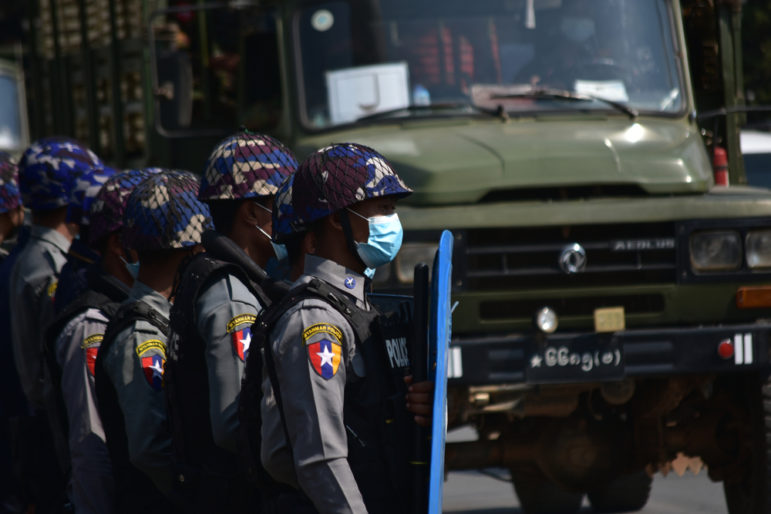
The Golden Triangle drug trade has reportedly boomed since the Myanmar military’s ouster of the government in early 2021 — but critics aren’t so sure. Image: Shutterstock
It is also up for debate whether more drugs actually are being produced in the Golden Triangle. The Transnational Institute notes that the increases in seizures that have taken place since 2021 could be for other reasons, and these do not automatically mean that there has been an increased equivalent in production. As a result, reports of sudden, huge increases in production should be treated with caution, the TNI stated in a report from December 2021.
In June 2022, Myanmar’s military government celebrated the UN’s World Drug Day by burning what it claimed was US$642 million worth of drugs. But David Mathieson, an independent researcher, told Agence France-Presse this public show of resolve was part of a “decades-long delusion.”
“The military pretends to get serious about drug eradication and the West pretends to believe them,” Mathieson told Agence France-Presse. He pointed out that there has always been “active military complicity in protecting large-scale drug production to ensure stability in [Myanmar’s] conflict zones.”
Case Studies
For an overall description of how corruption works in Thailand, see “Corruption and Democracy in Thailand,” written by Thai academics Pasuk Phongpaichit and Sungsidh Piriyarangsan. Although published in 2005, its basic analysis and conclusions remain valid.
In addition, Bertil Lintner covered the UN’s complicity in Myanmar’s drug problem and the myths it perpetuates in The Irrawaddy, a website run by Myanmar exiles. In an article from February 7, 2022: “The UNODC actually has a long history of covering up official complicity in the drug trade and blaming it on Myanmar’s ethnic armed organizations.”
Myanmar writer Kyaw Lin Htoon has done investigations of the Pansay militia for The Frontier, a Myanmar weekly. This Pansay militia, located in northern Shan State is allied with the Myanmar military and based “in and around (the border town of) Muse where gambling, drug trafficking, and sex work occurs openly — often close to the three official border crossings between Myanmar and China.” And as an example of how these local militias enjoy quasi-government recognition, Kyaw Myint, the commander of the Pansay militia, represented Muse in the Shan State assembly (local Myanmar parliament) from 2010 – 2015.
Chapter 3 — Money Laundering
The purpose of money laundering is to turn funds derived from illegal activities, such as the Golden Triangle drug trade, into legal assets such as bank deposits. Traditionally, incomes from the drug trade and other illicit activities in the Golden Triangle were laundered through banks in Thailand, Hong Kong, and Singapore. The funds would then be sent through a series of regional and international bank accounts and finally into a private or business account somewhere in the world, where it would be next to impossible to trace the origin of the money.
How It Works
According to international financial experts, money laundering goes through three main stages: placement, layering, and integration. It works like this:
Generally, the more layers that tainted money passes through, the harder it becomes for law enforcement authorities to track funds back to any criminal activity.
Placement. Drug addicts and small-scale dealers pay in cash to their suppliers, who end up with lots of paper currency in different denominations, which have to be deposited — or “placed” — into bank accounts. Locally, that can be done by funneling them through other cash-intensive businesses such as bars, nightclubs, restaurants, supermarkets, and petrol stations. In Thailand and China, and to a lesser extent Laos and Myanmar, cash is brought to a bank and, if any questions are asked, the depositor can show that he or she is the owner of one of those entities. In countries outside the region, to which the drugs have been smuggled and sold to local addicts, money laundering can be done by a method known as “smurfing.” The nickname comes from so-called hired hands — “smurfs” — going in and out of different banks and making deposits of illegal funds into multiple accounts (often using various aliases). Most banks in Australia, the United States, and Europe have limits on how much cash can be deposited into a single account without it being reported to tax authorities. As a result, “smurfs” typically make deposits just under that limit. In this way, money enters the financial system without drawing the attention of governmental institutions or financial watchdogs.
Layering. This is the second step, whereby a money launderer breaks up large bank-to-bank transactions into a series of smaller transactions that fall under the reporting threshold of most Western financial institutions. In the US, Europe, Canada, and Australia, the daily limit for depositing or withdrawing money without the banks having to report it to governmental tax authorities is roughly US$10,000. Breaking up these transfers effectively disconnects money derived from illegal activities from the actual source, which could be drug trafficking or any related illicit business. Generally, the more layers that tainted money passes through, the harder it becomes for law enforcement authorities to track funds back to any criminal activity. Layering can include changing the nature of the origin of the assets, which could be claimed to be from the sale of gold, winnings at a legal casino in Macau or elsewhere, legitimate real-estate deals, or other above-board ventures. This is often done by sending the money around the globe using a series of transactions involving “tax havens” and “financial services centers” in offshore locations. The more jurisdictions the money passes through, the harder it becomes for the authorities to uncover the actual source of the money.
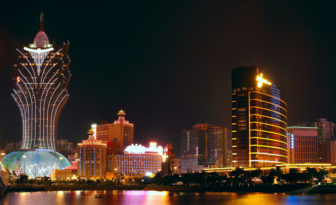
Claiming winnings from casinos in Macau can be a way to hide dirty drug money, making it harder to track back to its source. Image: Shutterstock
Integration. In the final stage, once the illegal assets have been placed, layered, and hidden behind supposedly legal business enterprises and bank deposits, the funds have to be integrated into the legitimate financial system. This must be done through legal sources to create a plausible explanation for where the money originates. This money is then sent back to the people from the criminal organizations that invested in the Golden Triangle drug trade or other illicit activities. After this third stage, it becomes next to impossible for law enforcement agencies to distinguish between legal and illegal incomes, and the criminal organization that laundered the money can now use it with little or no chance of getting caught. The previously “dirty” money has been successfully cleaned and absorbed into the mainstream economy, and can now be used for investment in real estate or other legitimate business enterprises, or simply to finance the criminals’ lavish lifestyles.
However, in some countries such as Thailand, following all three steps may not be necessary, since large amounts of funds can usually be deposited into one account and transferred to an overseas bank with no questions asked. But if that destination account is in a country such as the US, Canada, Australia, or Europe, transfers would still have to be broken up into smaller amounts to avoid the reporting requirement.
In addition, there is also a local method for hiding dirty money from the prying eyes of international financial authorities: underground banking systems. In South Asia and the Middle East, this underground network is called hawala, in Southeast and East Asia it is called hai wai (“overseas”), hui kuan (“remittances”), or chao hui, which means currency investment or speculation. Some refer to it as fei qien, or “flying money,” which is something of a misnomer given that, as in hawala, the money never actually leaves the place where it was originally deposited. These “underground banks” can transfer money worldwide faster and more efficiently than ordinary banks, which are burdened by bureaucracy and legal restrictions. These banks leave no paper trail to be scrutinized by local tax authorities or intelligence agencies, which are trying, often in vain, to track the global flow of illicit and semi-illicit “gray” money (i.e. earnings from “tax avoidance” or unfair business practices).
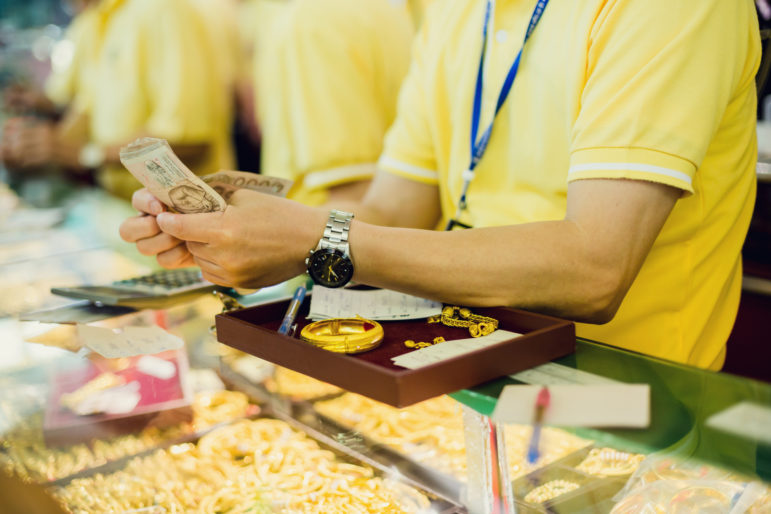
A gold dealer in Yaowarat, Bangkok. “Fei qien” or “flying money” operators often double as a travel agents, money changers, or gold dealers, crediting funds from one such business to another. Image: Koonsiri Boonnak/iStock
How it works: a hawaladhar or a fei qien operator often doubles as a travel agent, money changer, or gold dealer. If a criminal wants to transfer money from, for instance, Chiang Mai in northern Thailand to China, Hong Kong, Singapore, or Dubai, he can deposit any amount of cash into one such enterprise and another — or the same — person can pick up the same amount at a connected travel agent, money-changer, or gold dealer in any of those jurisdictions. In other words, if a Chinese businessman wants to transfer money to Thailand, he can pay Chinese renminbi to a travel agent or gold dealer in Kunming or Hong Kong and pick up the equivalent in Thai baht from a money changer in Chiang Mai or a gold shop in Bangkok. In the past, a banknote ripped in two — one part for the person who was going to pick up the money and the other for those who were going to hand it over — was used to identify the sender and the receiver of the transaction. These days, all that is needed is a coded phone call, SMS, or email.
International law enforcement agencies have not been particularly successful in trying to stem the flow of money through Asia’s underground banks.
An underground banking operator can also move money out of a country by importing goods at overvalued prices and exporting goods at undervalued prices and vice versa. Almost any type of product can be used as cover for this laundering tactic: electronics, textiles, expensive carpets, foodstuffs, or building materials. Regardless of which one is used, the parties involved still have to balance their books since someone is running a deficit and somebody a surplus. This can be done through more informal transfers or by personally visiting banks to collect the cash in a local currency or in US dollars. Anywhere from one to four times a year, the various members of the drug network communicate with each other and settle their ill-gotten balances.
But the whole system depends on trust, and if the trust is violated, the consequences can be severe for anyone who tries to run off with the money. International law enforcement agencies have not been particularly successful in trying to stem the flow of money through Asia’s underground banks. After 9/11, the US tried to crack down on hawaladhars in Dubai and elsewhere in the Middle East because they had been used to finance terrorist activities. Fei qien operators were also targeted, but two decades later, they — and the hawaladhars — are once again operating with impunity, and spreading their tentacles across Asia, including the Golden Triangle.
Background
The region’s economic boom began when, in March and April 1989, the hill tribe rank-and-file of the insurgent Communist Party of Burma (CPB) mutinied against its aging, orthodox, mainly Burman leadership and drove them into exile in China. Four ethnic armies emerged from the old CPB, and that coincided with the flight of thousands of pro-democracy activists from urban centers to the frontier areas. They had fled from massacres in the old capital Yangon and other cities and towns and wanted to fight together with the ethnic rebels against a new military government that had seized power in September 1988. But those ethnic armies had only a handful of weapons that they could share with the urban activists. Only the former CPB forces had warehouses of weapons which had been supplied by China during the decade 1968-1978. With now only ethnic rebels in the country, there was the possibility of an alliance between the former CPB forces, now ethnic armies, and the other resistance forces, which could have changed the course of Myanmar’s decades-long civil wars. In order to thwart that threat, the new junta in Yangon approached the CPB mutineers and made them an offer: maintain control over your respective areas and keep your guns — and you can engage in any kind of business as long as you don’t fight us and don’t share your arsenal with the other rebel groups. The mutineers, who controlled vast poppy growing areas in the Golden Triangle, accepted the offer, and opium production more than doubled within a year after the mutiny.
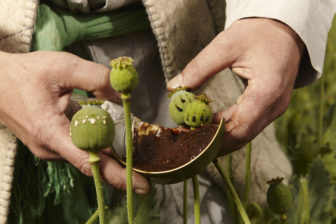
Farmers harvest raw opium by using tools to scrape lines into the plant’s pods, which then leak raw opium, and is collected and dried into opium gum. Image: Shutterstock
The threat against the junta had been neutralized, but the cease-fire agreements also meant that an entirely new era in the Golden Triangle drug trade was ushered in — and with it came huge amounts of money that had to be laundered, some of it through the newly established casinos, but most of it through banks in Myanmar and Thailand.
When methamphetamines joined opium as a Golden Triangle drug production staple, the region also experienced the arrival of an abundance of casinos, in which drug money and income from other illicit activities can be easily laundered. This new boom in gambling centers, many of which count organized crime gangs as investors, was fueled by the establishment of the so-called Special Economic Zones to promote business in northwestern Laos and eastern and northern Myanmar. According to the United Nations Office on Drugs and Crime (UNODC), “an estimated 240 casinos have been built in 120 SEZs in the Mekong subregion and some of these areas have become hubs of serious criminal activity.”
The first casinos were established in areas controlled by the National Democratic Alliance Army-Eastern Shan State (NDAA-ESS), one of the groups that emerged from the collapse of the Communist Party of Burma in 1989. This group’s headquarters at Mong La on the Chinese border was transformed from a village consisting mostly of bamboo huts to a modern city with luxury hotels, fancy restaurants, brothels, and many casinos. The NDAA-ESS was also involved in the drug trade and associated with other drug-trafficking groups in the Golden Triangle. Before the COVID-19 pandemic and the imposition of China’s “zero-COVID” policy, which still remains in force, thousands of tourists from China crossed the border each day to enjoy the entertainment that was provided in Mong La, in particular the casinos, because gambling is banned in China. This cross-border traffic led to a massive outflow of money from China — and the Chinese authorities have therefore on several occasions, tried to control the tourist trade in Mong La. But they’ve had limited success because the NDAA-ESS leadership has a relationship with China’s security agencies that goes back decades, to the Communist Party of Burma (CPB) days. Casinos were also established along the China-Myanmar border area controlled by the United Wa State Army (UWSA), the main ethnic force that emerged from the collapse of the CPB. But the UWSA earns most of its money from the trade in opium, heroin, and, now, methamphetamines.
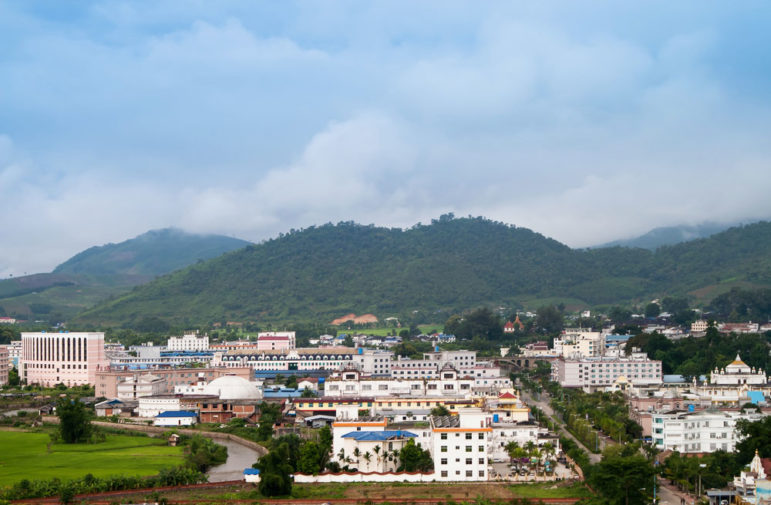
Mong La city in Shan State, Myanmar, borders China’s Yunnan province. Thanks to illicit money and Chinese tourists, Mong La has been transformed from a sleepy village into a modern city with luxury hotels, upscale restaurants, brothels, and many casinos. Image: Shutterstock
Tips and Tools
Writing about these issues is a challenge. First of all, it is difficult to prove that money has been laundered for the simple reason that the goal is to make illicit funds untraceable. Many people who are involved in these activities are also prone to suing journalists who have dared to expose them. The best way to approach the problem is to describe how the system works without pinpointing anyone in particular unless an allegation can be backed up by legal documentation.
It is also risky to physically enter the casino enclaves as a journalist. The only way would be to work undercover and pose as a would-be gambler, but utmost caution must be exercised when taking pictures. (For more on best practices of clandestine reporting, check out GIJN’s Guide to Undercover Reporting.)
Hiring trusted local collaborators such as experienced journalists and NGO workers is a must before venturing into these areas, because the local police in Thailand as well as in Myanmar, Laos, China, and Cambodia are often on the criminals’ payroll.
At the same time, a visit to the Golden Triangle casinos has to be followed up by internet searches, and there are many links such as these:
Educate yourself on money laundering and terrorist financing. Read this website put together by the Financial Action Task Force (FATF), a global money laundering and terrorist financing watchdog.
Here’s a list of useful websites related to money laundering.
Use the World Casino Directory to collect information on casinos in the region.
Read about the Australian police’s definition of cuckoo-smurfing along with its guide on financial crime.
For more information about drug trafficking spilling over into domestic markets read this paper by the Lowy Institute in Australia.
If you’re interested in Mong La, Vice traveled to “the town where you can buy drugs, sex, and endangered animals.” Time Magazine did a story on Burma’s “debauched land of drugs and vice,” while the Institute of East Asian Studies at UC Berkeley also published this paper on the region.
Read here what the UNODC is saying on casinos in the Laos and Myanmar Special Economic Zones and this story from The Diplomat on what it calls the “casino scam archipelago.”
This is a story on the activities of a Chinese businessman in the region, who’s on the US sanctions list.
Case Studies
How money-laundering works was outlined in a March 2010 cover story for Finance Asia. Although written more than ten years ago, the manner in which money laundering is explained and investigated remains more or less the same. GIJN published its global Guide to Investigating Money Laundering and Financial Crime in 2021.
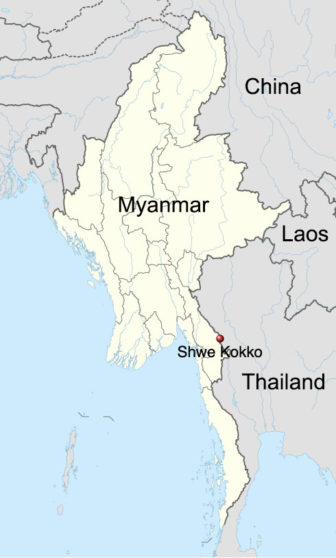
Shwe Kokko, one of two “Chinatowns” that have emerged on the Thai-Myanmar border south of the actual Golden Triangle. Source: Wikipedia
For the present situation on the ground in the Golden Triangle, which has not changed since the February 2021 military takeover in Myanmar (the Ministry of Border Affairs has always been under military, not civil, control), see this 2019 investigative piece in Asia Times. It describes how two “Chinatowns” have emerged in areas on the Thai-Myanmar border to the south of the actual Golden Triangle, which are controlled by former ethnic Karen rebels who have made peace with the Myanmar military and are now so-called “Border Guard Forces.” The first was Shwe Kokko, an enclave across Thailand’s border with Myanmar, some 500 kilometers northwest of Bangkok and 420 kilometers east of Yangon, Myanmar’s commercial capital. Technically inside Myanmar, but more easily accessible from the Thai side of the Moei, new, massive buildings have been constructed there. Some are hotels and apartment blocks, while others house restaurants, karaoke bars, beauty salons — and casinos. The Chinese-built project covers 2,000 acres, or more than 800 hectares, and has been approved by the official Myanmar Investment Commission. According to the Asia Times story, the investment is backed by a Chinese state company which was registered with the Myanmar Ministry of Planning and Finance. When completed it will include shopping malls, trade centers, golf courses, and perhaps even an airport.
A similar project is underway inside Myanmar south of Mae Sot, and also in an area controlled by a Karen ethnic armed group that has entered into a ceasefire agreement with the Myanmar military. The investors are ethnic Chinese who previously operated in Cambodia. They relocated to Myanmar after Hun Sen’s government in Phnom Penh introduced new legislation in 2020 that restricted the casino industry in Sihanoukville. The main player in this second casino zone is Wan Kuok Koi — known by the alias “Broken Tooth”— a gangster who previously spent 13 years in a Macau prison on charges of involvement with an “illegal organization,” in this case, the local chapter of the 14-K Triad. He was released in 2012 and, according to a 2020 report in The Irrawaddy, set up a number of legitimate-looking front groups and enterprises, which could not have been done without some kind of cooperation with powerful Chinese business interests.
In August 2022, one of Wan Kuok Koi’s associates was arrested in Bangkok on charges of running an illegal online casino. This man reportedly invested in gambling ventures in Cambodia and the Myanmar border village of Shwe Kokko as well as a lottery venture in the Philippines. Both online and traditional casinos continue to operate in Shwe Kokko and the gambling zone south of Mae Sot.

Construction of the Kings Romans Casino in Laos, viewed from the Thailand side of the Mekong river. The casino is located in a Special Economic Zone, where Chinese businessmen have invested vast sums of money in tax-free development projects. Image: Shutterstock
Another place that has attracted the attention of law enforcement agencies, as well as investigative reporters, is the Kings Romans Casino in Laos, located at the intersection of the Laos, Thailand, and Myanmar borders. It is part of the Golden Triangle Special Economic Zone (GTSEZ), where Chinese businessmen have invested vast sums of money in tax-free development projects. Kings Romans has been granted a 99-year lease, at the end of which all properties are supposed to be handed over to the Laotian government. Kings Romans has its own security force inside and outside the casino, where visitors will find slot machines as well as games such as baccarat, blackjack, and roulette. In 2017, The New York Times ran an article highlighting the trade in illegal wildlife at the casino and how its zoo is used as a holding station for slaughtering tigers and other endangered species. The US Treasury Department has also linked Kings Romans to drug trafficking and money laundering.
As shown above, there is plenty of background material that can be used, but remember to bring something new to the reporting about casinos in the Golden Triangle and related money laundering issues. The story has to be brought forward and one way to do that would be to “follow the money” back and find out in whose pockets it ends up.
Chapter 4 — Human Trafficking
The networks that smuggle people through the Golden Triangle are essentially the same as those that trade in drugs. The reason is simple: only those gangs know the routes and have the necessary contacts. The first trafficked peoples to flow through this region were Chinese citizens who wanted to go to the United States — the preferred destination — but also to Japan, Taiwan, Australia, or Europe — anywhere that the migrants could attain their dream of a better life. But thanks to rising living standards in China, what was once a flood has become a trickle.
Following the February 2021 military coup in Myanmar, more people from that country are fleeing the junta’s rule and worsening economic conditions.
In the next wave were North Koreans, who made the perilous journey through China to Laos and then northern Thailand, where they were processed by Thai and South Korean authorities as seeking political asylum and then allowed to continue to South Korea. They were, in other words, treated differently from other people who had been smuggled through the Golden Triangle. North Koreans are still coming to Thailand, but more controls have made it increasingly difficult to smuggle people across China, and the COVID-19 pandemic has made it much more difficult. Now, in a new wave of migrants, men and women from Myanmar are escaping hardships in their home country and looking for jobs in Thailand. Following the February 2021 military coup in Myanmar, more people from that country are fleeing the junta’s rule and worsening economic conditions.
Trafficking within the Golden Triangle
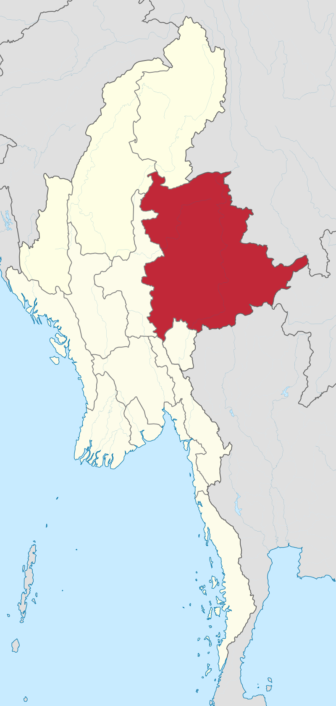
Many migrants from Myanmar’s Shan State (in red) cross the country’s southern border into northern Thailand to find work. Image: Wikipedia/Creative Commons
Political turmoil, a severe economic crisis, and general underdevelopment in Myanmar have compelled millions of people to flee across the border to Thailand. The International Labor Organization (ILO) stated in a 2019 report that there were 2.9 million registered migrant workers in Thailand, comprising 7.6% of the workforce.
The actual figure, including all those who are not registered, could be at least twice that number. Those in the northern Thai city of Chiang Mai are mostly Shan and have come across the mountains from the Myanmar sector of the Golden Triangle, escorted by gangs that charge a fortune for smuggling people into Thailand. The Shans, Myanmar’s largest ethnic minority group, are closely related to the Thais when it comes to language and culture (the Shans call themselves Tai, the Thais refer to them as Thai Yai), which makes Thailand an attractive destination for many Shans. These migrants from Myanmar dominate the workforce in Chiang Mai’s construction sector, while many Shans work as farm hands or perform other low-wage, menial labor that Thais are reluctant to do. These migrant workers are often cheated out of their salaries and mistreated. The Thai police often apprehend them for minor offenses and then demand bribes. Despite being closely related to the Thais, the Shans also face prejudice from the local population in northern Thailand.
Most Myanmar workers in Thailand are heavily indebted to the gangs that transported them across the border. According to a Deutsche Welle report published in July 2022: “Ten years ago, horrifying reports of extreme debt bondage surfaced from Thailand’s commercial fishing industry, shocking consumers into reconsidering their position on one of Thailand’s leading sectors.” Much of that trade in humans involves criminal gangs that are active in the Golden Triangle.
Apart from being a center for money laundering and drug trafficking, the Golden Triangle Special Economic Zone (GTSEZ), with its Kings Roman casino in Laos, has also become a hub for human trafficking. Many of the victims are young Lao women who have been lured into prostitution, according to a March 2022 report by Radio Free Asia. “Many… women and girls are exploited, abused and victimized by human trafficking,” a member of the Lao Women’s Union of Nomo district told RFA. ‘They’re from poor families, uneducated, unaware of the risk, and sold.”
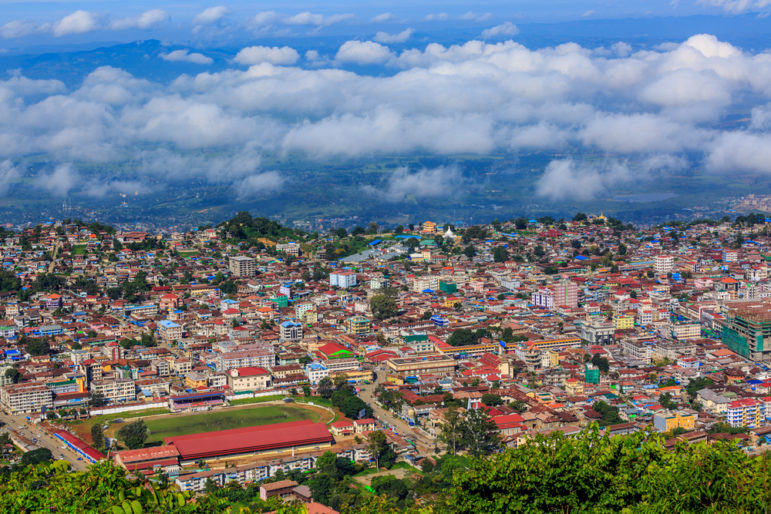
Taunggyi, the capital and largest city of Myanmar’s Shan State. Political turmoil and economic issues have caused many Shan — Myanmar’s largest ethnic minority — to flee across the border into Thailand. Image: Shutterstock
In the Thai city of Mae Sot, 500 kilometers northwest of Bangkok, thousands of Myanmar workers are employed in local industries. Thousands of Myanmar migrants also work in the fishing industry, which is mainly based in Mahachai near Bangkok. Some migrants in Mae Sot have tried to organize unions, but that is illegal under Thai law (only citizens are allowed to join unions).
Very few Chinese people have been able to travel to Thailand since the COVID-19 pandemic broke out in 2020, but those who came before it belong to a category that differs markedly from what the migrants from Myanmar have to endure. Most were casual visitors but some came to stay, and they have money and are able to buy some kind of Thai ID documents. That was usually done by first staying in one of the old Kuomintang settlements in the Thai sector of the Golden Triangle (Mae Salong, Tam Ngob, Ban Mai Nong Bua, Phatang, and others.)
The only way to effectively investigate the trade in humans from Myanmar to Thailand is to go to the towns where the migrants live.
Being Chinese, they can also, for a fee, be included in the house registration of Chinese families that have lived in Thailand for generations and are now citizens. The next illicit step toward achieving more legitimate status is to upgrade that local ID to a bat prachachon, or citizenship card. This trade is difficult for migrants — and risky to investigate — because it involves local, ethnic Chinese “strongmen” as well as corrupt local Thai officials.
Tips and Tools
General tips on how to cover human trafficking in general can be found in this GIJN story and at GIJN’s Resource Center.
The only way to effectively investigate the trade in humans from Myanmar to Thailand is to go to the towns where the migrants live: Mae Sot, Chiang Mai, Mae Sai, Mae Hong Son, and Samut Sakhon. Local journalists, trade union organizers, and NGOs are the best sources.
For background information to the specific situation in Southeast Asia, there are several internet resources:
This 2022 US Department of State report includes recommendations to the Laos government to tackle human trafficking, but also analyzes the current state of prosecution, protection, and prevention.
This report published by the Southeast Asia Research Centre (SEARC) of the City University of Hong Kong assesses the situation of Burmese migrant workers in Mae Sot in Thailand. This paper is housed on the free Online Burma/Myanmar Library, which claims to be the largest single resource of material on Burma and can serve as a great resource to journalists.
When investigating labor issues in the region, contact local NGOs that are trying to support migrant workers in the region like the MAP Foundation or the international Union Aid Abroad APHEDA.
A 2020 study of Thailand’s fishing sector by the International Labour Organization found that 14% of those working in fisheries were coerced to work there. Although things are improving, according to the ILO, “nearly three-quarters of workers surveyed in 2019 — both fishing and seafood processing — reported that they found work or were recruited via their family and friends. This shift since 2017 away from registered agents and brokers appears to have reduced recruitment fees, but fishers, in particular, continue to report owing debts to employers for migration costs with attendant reports of wage withholding, deception and coercion.”
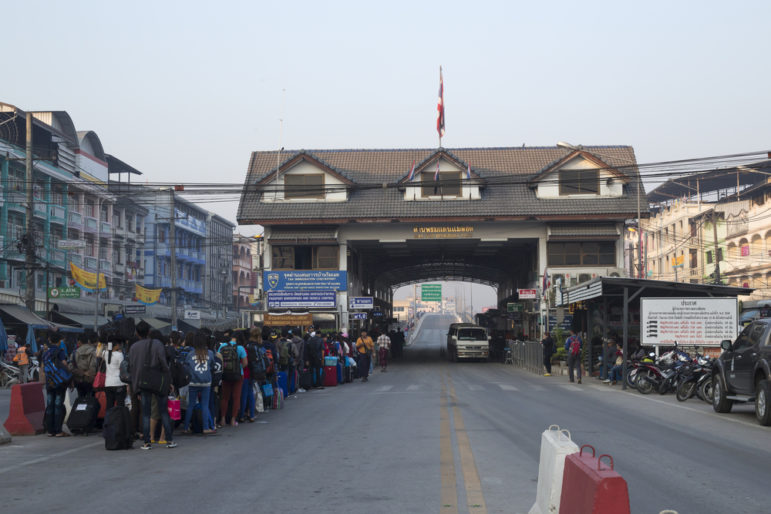
Migrants from Myanmar waiting to cross the border at the Thai-Myanmar Friendship Bridge, which connects the Thai city of Mae Sot to Myawaddy in Myanmar. Thousands of Myanmar workers are employed in local industries in Mae Sot. Image: Shutterstock
Case Studies
There is very little available about recent developments in human trafficking through the Golden Triangle and adjacent areas. One exception is an Al Jazeera story on Myanmar workers trafficked to Thailand, who live in a country that doesn’t recognize them and where they have few labor rights and no right to unionize.
The Diplomat also covered the issue in an August 2022 article. That story includes details of how Chinese-speaking people have been kidnapped and forced to work for criminal gangs in Myanmar. Hundreds of English-speaking Indians and Pakistanis have also been trafficked to Myanmar to run cybercrime operations, including online casinos. According to reports in Indian media, the total number of these trafficking victims is believed to be at least 300.
This piece by Nathan Paul Southern and Lindsey Kennedy on modern slavery in the GTSEZ was published in October 2022, and describes the lives of trafficking victims forced to work in casinos, online scams, and brothels. In a Sydney Morning Herald piece, Southern and Kennedy focus on the online scams from the GTSEZ and explain how “all across South-East Asia, heavily guarded, sinister compounds have sprung up to house these industrial-scale scam operations — and to trap people forced to work for them in terrifying conditions.”
Chapter 5 — Wildlife Trafficking
The once-sleepy town of Mong La, on Myanmar’s border with China, first became a center for drug-trafficking and gambling but now has also developed into a hub for the illegal trade in wildlife products.
This was highlighted as early as 2017 in a report compiled by Traffic, an NGO mapping the illegal trade in wild animals and plants. Based on its investigations, including visits to Mong La, Traffic identified 10 of the most widely trafficked animal products in the Golden Triangle: tiger skins, paws, and bones; parts of elephants such as ivory, teeth, hair, bones, tails and trunks; meat and scales from pangolins; bears and especially their bile; rhinoceros horns; serows (a goat- or antilope-like species); hornbills (a bird species); the bison-like gaurs; leopard skins; and various kinds of turtles. The main market is China, where rhinoceros horns are believed to be an aphrodisiac, while bear bile and pangolin meat are considered a delicacy. Pangolin scales are also popular in traditional medicine in China and Vietnam. Wildlife products for sale in Mong La come from Myanmar itself but also from northeastern India (rhino horns and tiger products) and as far away as Africa (rhino horns).
Wildlife products are also for sale in the Golden Triangle Special Economic Zone (GTSEZ) in Laos’s Bokeo Province. According to the NGO Environmental Investigation Agency (EIA), there are even a number of criminal-run tiger “farms” inside the GTSEZ where tigers are bred and then sold. EIA wrote in a 2015 report: “The complex comprises a casino, hotels, shops, restaurants, a shooting range, and massage parlors — and visitors can openly buy endangered species products including tigers, leopards, elephants, rhinos, pangolins, helmeted hornbills, snakes and bears, all smuggled in from Asia and Africa.”

In a 2015 report, the Environmental Investigation Agency tracked the trade in tigers and tiger products through the Golden Triangle Special Economic Zone (GTSEZ). Image: EIA
This trade is run by international criminal gangs that are also involved in narcotics, money laundering, and human trafficking. The exact value of the Golden Triangle trade in wildlife products is not known but the total global trade is reported to be in the order of US$23 billion. According to the European Commission, illegal trafficking in wildlife products is believed to be the fourth-most lucrative transnational crime after drugs, weapons, and human trafficking. Due to the lawless nature of the Golden Triangle, it is hardly surprising that a large part of the regional as well as global wildlife trade takes place there.
How It Works
A detailed report on how the illegal wildlife trade in the Golden Triangle works was published in the scholarly journal Trends in Organized Crime 2021. The growth of the trade in wildlife came in the wake of the major events in the Golden Triangle and adjacent territories, including the 1989 collapse of the Communist Party of Burma (CPB) and China’s economic boom in the 1990s, which resulted in the emergence of a new class of Chinese entrepreneurs in search of business opportunities. The former CPB forces’ deal with the Myanmar government, which enabled them to set up autonomous areas along the Chinese frontier and expand their involvement in the drug trade, made it possible for them to engage in other types of illegal activities — and one of the most lucrative turned out to be the trade in wildlife products.
Investment Monitor branded the GTSEZ “the world’s worst special economic zone” in 2022.
Mong La, under the control of the National Democratic Alliance Army-Eastern Shan State (NDAA-ESS), became the main center for that trade. The group’s leaders had excellent contacts with local officials across the border in China’s Yunnan province as well as with ethnic Chinese criminal organizations. At the same time, a series of policy initiatives in Laos encouraged a more open market-oriented economy. Private traders were allowed to compete with state enterprises and the cross-border trade with China increased dramatically as a result of these new policies. As the authors of the article in Trends in Organized Crime point out: “This… strengthened China’s long standing connections with northern Laos and eastern Myanmar. However, it also facilitated cross-border trafficking of contraband and provided opportunities for crime groups to diversify into new illegal markets in the borderlands of the Golden Triangle.”
This shift in Lao economic policy led to the establishment of the GTSEZ in 2007. Its reputation for lawlessness soon became well-known and, in 2022, Investment Monitor branded it “the world’s worst special economic zone.” A major reason for this stems from the Lao government’s decision to lease the GTSEZ land to the Kings Romans Group, a Hong Kong-registered company. As a result, the zone no longer falls within the jurisdiction of the government in Vientiane. This arrangement is essentially permanent, since the lease was signed in 2007 and lasts for 99 years.
Radio Free Asia (RFA) reported on June 25, 2021 that there are even plans to build an international airport inside the zone. RFA also reported that the chairman of a Kings Romans affiliate that actually runs the casino “has been tied to human trafficking, money laundering, and the illegal trade in drugs and wildlife products.” In 2018, the US Treasury Department declared this business network, including the Golden Triangle’s well-known Kings Romans Casino, a “transnational criminal organization” and sanctioned the chairman as well as related individuals and companies across Laos, Thailand, and Hong Kong.
Origins and Markets for Wildlife Trafficking
When reporting on ethnically-based crime, it is important to remember that entire communities should not be besmirched and made out to be criminals. “Ethnically-based crime” simply means that criminals from a certain ethnic group find it easier to deal with, and trust, people from the same community — and that is the case when it comes to wildlife products. Ethnic Chinese crime gangs, drawing on the worldwide Chinese diaspora, operate all over Southeast Asia, North and South America, and South Africa as well.

The poaching of tigers for the global trade of their skins may be outsourced to local organized crime elements. Image: Shutterstock
Chinese crime gangs use South Africa as a regional base and rely upon local connections to move wildlife products from across southern Africa to places such as Mong La, one of few locations in the world where the trade can be conducted openly. But the trade is more complex than that. According to Trends in Organized Crime: “The organized crime group may then outsource certain illegal activities to local crime groups… for example, a crime group involved in the trade of tiger skins may outsource the task of poaching, product promotion and product delivery to local crime groups.” From Mong La and the GTSEZ, wildlife products are smuggled into China, the main market, but also Vietnam where there is a demand for what is termed “traditional medicine.”
Recent developments, especially in the post-COVID-19 era, are outlined in a 2021 report published by the Center for Strategic and International Studies. It looked into the digitalization of illegal wildlife trafficking, a new trend that has made combating crimes exponentially more difficult and, therefore, harder to report on.
Tips and Tools
The GTSEZ is easily accessible from the Thai side via speedboats that cross the Mekong River from Chiang Saen to the casino complex in Laos. (Citizens of most countries can get 30-day visas on arrival on the Lao side and the fee is around US$35). It is far more difficult to get to Mong La in Myanmar, however. Previously, foreigners could travel overland from Kengtung in eastern Myanmar, but that route has been closed for quite some time. It could be easier for Asian travelers because, unlike Westerners, they are seldom checked. Kengtung is in a government-controlled area and there is a “border” between it and the territory controlled by the NDAA-ESS and soldiers from both that group and the Myanmar Army check all arrivals on their respective sides of the “border.”
Extreme caution should be observed when entering the GTSEZ as well as Mong La (if that is possible), especially when taking photographs. Remember that those places are run by ruthless criminals who would not hesitate to harm foreign journalists snooping into their affairs. But it is possible to get a feel for those places, and what goes on there, simply by walking around and exploring the casinos, markets, and entertainment venues.
Apart from the links mentioned above, there is a trove of information available online. Traffic, the NGO, has compiled a very comprehensive identification guide to assist enforcement officers combat wildlife crime in the Golden Triangle and a detailed report on the big cat trade in Myanmar and Thailand. China’s role as the world’s foremost market for wildlife is outlined in a 2021 paper published by Frontiers. Mongabay, a conservation news web portal devoted to environmental issues, has also compiled some reports about the Golden Triangle wildlife trade, which can be found here, here, and here. The first gives a general overview while the second lists the most widely traded animals. The third, the most recent of those reports, contains undercover video footage of a tiger farm “run by an organized criminal organization” in Laos.
There are also NGOs in Thailand that investigate the illegal trade in wildlife products, and the best informed is Traffic. The EIA is another useful source, and so is the World Wildlife Fund.
Case Studies
In the past — and before the Myanmar government made it difficult for foreigners to travel in sensitive frontier areas — several journalists visited Mong La. One of the most comprehensive articles written during that time appeared in the June 2016 issue of Cross-Currents: East Asian History and Culture Review. The authors — Alessandro Rippa and Martin Saxer — give a vivid description of the city, the illegal activities there, and a historical background to the emergence of this unique, lawless area along Myanmar’s border with China. They wrote: “Mong La’s success is… based on a network of gamblers, smugglers, ex-communists, rebel army leaders, and drug lords.” They could, however, have added corrupt officials on the Chinese side of the border as well as in Myanmar government-held areas south of the NDAA-ESS’s self-governed zone.

Journalists traveling to Mong La, Myanmar, should exercise extreme caution, especially when taking photographs. Image: Shutterstock
Mizzima, a website run by Myanmar exiles, published a very good 2020 report on Mong La. Written by Sai Wansai, who belongs to the Shan ethnic group, it quoted extensively from studies written by Myanmar academics before the 2021 coup. Apart from outlining developments in Mong La, Sai Wansai also looked into the illegal wildlife trade in Kachin State in northernmost Myanmar. Due to the difficulties getting into the NDAA-ESS area would entail, no more recent articles from Mong La have been done as of late 2022.
Arrests of smugglers elsewhere have been covered in the international media. One recent example is an October 2022 report from Al Jazeera on the extradition of an alleged Malaysian wildlife trafficker to the US to face charges of participating in a conspiracy to smuggle 70 kilograms of rhino horns, valued at more than US$725,000. According to the US Treasury Department, the suspect “specializes in the transportation of rhino horn, ivory, and pangolins from Africa, generally utilizing routes through Malaysia and Laos and onward to consumers in Vietnam and China.” That would most certainly involve gangs in the GTSEZ, because they are the only ones with networks that span Laos, Vietnam, and China.
In August 2018, the Lao government announced that it would close down the illegal trade in wildlife in the Golden Triangle. But, as a 2020 investigative piece on the website Lifegate reported, that did not stop illegal wildlife trafficking. Instead, the practice transitioned to “under the counter, with illegal traders and wildlife criminals resorting to social media platforms for their sales. The Chinese messaging, social media, and payment app WeChat is increasingly being used as a means for the illegal wildlife trade.”
India is another country where there is a demand for exotic and endangered species, as shown in a 2022 article in The Diplomat. Among these targeted animals are chimpanzees, pangolins, snakes, lizards, and wild cats. They are smuggled from Myanmar into the northeastern Indian states of Mizoram and Manipur. The inclusion of chimpanzees, which are not found in the wild in Myanmar, shows that the network has global connections. According to Rajeev Bhattacharyya, an investigative journalist based in Guwahati in northeastern India: “India is both a source and a transit country for illegal wildlife and wildlife items [and] ranks among the top 20 countries for wildlife trafficking.”
Chapter 6 — Other Criminal Activity
Apart from being notorious for drug trafficking, wildlife smuggling, and illegal migration, the Golden Triangle has also become one of the world’s leading areas for unlawful mining, logging, antiquities trading, and arms production.
Mining for rare earth metals is by far the most lucrative of those illicit activities. Rare earth metals are essential ingredients in such products as cell phones, computers, electric vehicles, and defense applications such as guidance systems, lasers, radar, and sonar.
The mining in Myanmar is illegal because no official export licenses are issued, but the military turns a blind eye to it because of its ceasefire agreement with the United Wa State Army (UWSA), which controls most of the mines. Rare earth mining especially has become a major income for the UWSA, possibly rivaling the drug trade in profitability. China is the main destination of these minerals, which are used in the electronics industry without foreign customers knowing where they came from. Jade, too, has been smuggled to Thailand and China for decades, but that trade could be considered semi-legal as some miners and traders do have export licenses.
The establishment of autonomous zones for the former rebel groups… has turned the Golden Triangle into a haven for every imaginable kind of crime.
Antiquities such as ancient Buddha statues, palm leaf scriptures, and other items from temples, as well as old coins, jewelry, and artifacts, are routinely smuggled into Thailand from Myanmar. The illegal trade in antiquities has become more difficult because of international supervision and restrictions on the importation of such goods into primarily Western countries. But there is a slow but growing demand in China for particular types of ancient, line decorated beads, which apparently can only be found in historical sites in Myanmar and are of religious significance.
Timber trading in the 1990s and early 2000s was a massive enterprise in the region with entire areas inside Myanmar being denuded. The practice, which had both legal and illegal aspects, has declined in recent years, though, because of export restrictions put in place by China — the main destination for illicit logging — and the fact that much of the forests in northern and northeastern Myanmar are now gone. The exact value of the trade in all these goods is not known, but, put together, it is likely close to billions of US dollars.
Guns are produced in clandestine factories in Shan and Kachin States and are both sold and used locally. Gun production is still important as a source of income for the former Communist Party of Burma (CPB) rebel group in Kachin State, while the Kachin Independence Army (KIA) and the UWSA produce guns for use in their own armed forces from raw material smuggled in from China and with the help of Chinese engineers. Some of these regionally-produced guns have also found their way to ethnic rebel groups in Nagaland and Manipur in northeastern India as well, making the production an issue of regional concern.
The lawless nature of the Golden Triangle caused by decades of civil war has, somewhat ironically, been exacerbated by the ceasefire agreements the Myanmar military has signed with various rebel groups since 1989. The establishment of autonomous zones for the former rebel groups — along with promises that they can run any kind of business to support themselves — has turned the Golden Triangle into a haven for every imaginable kind of crime. The dramatic rise in narcotics production, first opium, then heroin, and now methamphetamine, has been followed by a multi-million dollar trade in minerals.
‘Blood Jade’ Trade
The jade trade is the oldest of any mining activity within the present borders of Myanmar. High-quality, imperial green jade can be found only in the Hpakant area of western Kachin State, and it has been mined there for more than 1,000 years. Jade has an almost religious significance in Chinese culture, where it is known as the “Stone of Heaven” and the main market, therefore, has always been China. Only wars and revolutions have disrupted the trade. When the border has been open, the trade has been legal. But when the borders have been closed — for instance, during the military’s “Burmese Way to Socialism” era (1962-1988) — jade trading was technically illegal, but still took place because of corruption within Myanmar’s ruling military. Even today, some jade is exported to China illegally to avoid paying taxes and other duties.
The end of the Chinese civil war and the proclamation of the People’s Republic of China in 1949 brought cross-border trade to a halt, and it was not resumed until the early 1990s when China as well as Myanmar introduced free-market reforms. Until then, jade had been smuggled from northern Myanmar to Chiang Mai in northern Thailand, which became the center for the regional jade trade. Once in Thailand, the commodity was no longer considered contraband and exporters could legally trade the stone to buyers in Hong Kong, Taiwan, and Singapore.

A large mass of jade prepped for carving in Chiang Mai. Illegally mined jade from Myanmar is often smuggled across the border into northern Thailand. Image: Flickr (Creative Commons 2.0)
The Kachin State town of Hpakant technically does not sit within the Golden Triangle, but the illegal jade trade originating from there has been carried out by various rebel armies and militias, some of which were also involved in the drug trade. The KIA has controlled the area around the mines (but not the actual mines), enabling it to collect taxes on the trade. For many decades, jade mining was officially illegal under Myanmar law but still tolerated because it brought in massive incomes to corrupt local government officials. The KIA also transported jade by mule caravans down to the Thai border where Nationalist-Chinese Kuomintang (KMT) militias had their camps.
Those camps themselves were not illegal; the Thais recognized the KMT as special border guard forces and mostly ignored the militia’s commercial activities, be it trafficking drugs or jade. One prominent KMT officer had a camp at Tam Ngob on the Myanmar border as well as a mansion in Chiang Mai, and he was involved in the drug trade as well as the jade business. The KIA, which also had a camp at Tam Ngob, was paid for its services and could buy guns in Thailand, which then were transported back into Kachin State by the same mule caravans that had carried jade down to the border. Another KMT general had a similar camp at Mae Salong, northwest of the northern Thai city of Chiang Rai. Golden Triangle drug lords such as Lo Hsing-han and Khun Sa also doubled as jade traders, and the jade trade became in all aspects closely linked to the trade in opium and heroin.
Today, jade trafficking has become a multi-billion-dollar business. Chiang Mai, however, has lost its significance as a trading hub since the jade is now transported directly across the border into China, or sold at official jade and gems auctions in Myanmar. The entire area around Hpakant has been turned into a moon-like landscape, and various private entrepreneurs — including Golden Triangle drug traffickers — are making vast fortunes from the trade, while working conditions at the mines are abysmal, leaving a trail of deaths. Some journalists and authors, therefore, have begun writing about the business as the battle for “blood jade.”
Rare Earth Mining
The ceasefire agreements between the Myanmar military and various rebel groups in the late 1980s and early 1990s laid the groundwork for other illegal and informal mining activities as well.
In a September 2021 report, the commodity research firm Roskill estimated that, as of 2020, at least half of Chinese-made electronics that require heavy rare earth elements (HREE) used minerals imported from Myanmar. In fact, the report stated that “all Chinese state-owned enterprises (SOEs), except for those focusing on light rare earths, have become reliant on Myanmar sources over the past four years, and now face supply chain risks with few alternative suppliers of HREE resources.”
China… is still heavily dependent on imports from Myanmar, including illegally trafficked rare earth minerals from militia-controlled border areas.
Most rare earth mines are located in areas under UWSA or New Democratic Army-Kachin (NDA-K) control. The latter is an armed group of former CPB forces that also made peace with the Myanmar military in 1989. Led by a former CPB commander, the NDA-K has its headquarters at Pangwa on the Chinese border and, in 2009, became a Border Guard Force allied with the Myanmar military. There are also at least two mines in KIA-controlled areas near the Chinese border, but their output there is limited compared with what is being extracted in the Pangwa area.
In addition, there are rare earth mines in other parts of the country that could be considered legitimate, as they are run under more direct supervision of the Myanmar government. Myanmar is, in fact, the world’s third-largest producer of rare earth metals after the United States and China. China, despite being the most prolific rare earth metal producer, is still heavily dependent on imports from Myanmar, including illegally trafficked rare earth minerals from militia-controlled border areas.
Illegal Logging
One consequence of the freedom granted to militia groups after the cease-fire agreements of the late 1980s and early 1990s was a boom in illegal logging. Hundreds of loaded timber trucks could be seen daily heading back into China from Myanmar’s sector of the Golden Triangle. The NGO Global Witness documented this practice and estimated that, in 2006, this illegal logging was worth US$250 million per year — and that 95% of Myanmar wood exports to China lacked licences and failed to pay the necessary taxes or duties. Since then, there has been a significant decline in those exports, but timber remains a notable source of income for several rebel groups and militias in the Golden Triangle.
Arms Production and Dealing
Another illegal activity that has taken off in recent years is the production and trade in weapons. Myanmar’s rebel groups have always had the capacity to repair old guns and make their own rifle ammunition and land mines, but, more recently, clandestine gun factories have been established in the Golden Triangle and adjacent areas. The first known such facility was set up in September 2006 near Kunma, 125 kilometers north of the UWSA’s headquarters at Panghsang on the Chinese border. It was reported to be manufacturing replicas of Chinese-designed M-22 assault rifles (the Chinese version of Russia’s AK-47, or Kalashnikov), M-23 light machine guns, and the 7.62-millimeter ammunition used by both weapons. Raw material and spare parts, as well as the technical expertise needed for the production, comes from China, and it is uncertain to what extent Chinese authorities are complicit in this gun trade. However, most of the weaponry in the UWSA’s arsenal — including infantry weapons, artillery, light armored cars, surface-to-air missiles, and even weaponized drones — are acquired from China.

Weapons cache of AK-47 rifles. Image: Shutterstock
The KIA, which does not have the same close relationship with the Chinese as the UWSA, has its own weapons factory where it produces assault rifles also based on Chinese designs and manufactured with raw material and parts from China. Those guns are used by the KIA’s troops and not sold to other rebel armies or militias. The KIA entered into a ceasefire agreement with the Myanmar military in 1994, but it fell apart in June 2011, and since then, heavy fighting has raged in northernmost Myanmar.
The NDA-K, with its headquarters at Pangwa, became a major player in a number of trafficking businesses soon after its ceasefire agreement in 1989. However, its lucrative trade in illicit timber deteriorated quickly once the forests were depleted, forcing the group to turn to poppy cultivation and heroin production. Today, as a Border Guard Force allied with the Myanmar military, the NDA-K remains active in the drug trade and has also established a gun factory at Pangwa that produces automatic rifles, pistols, revolvers, and shotguns. Among its arms customers are the ethnic Naga, Assamese, and Manipuri rebels from northeastern India, who have bases on the Myanmar side of the border in the upper Sagaing Region of that country. The group’s guns and drugs are transported through areas of Kachin State that are not controlled by the KIA — to avoid that local militia’s taxes on the goods — then up to Singkaling Hkamti in Sagaing Region and on to the rebel camps closer to the Indian border.
In addition, imported guns from China are also smuggled across the Myanmar border at Ruili and then to Muse and Lashio in northern Shan State, destined for Mandalay, Monywa, or the Indian border. Weapons from Thailand are also found all over the Golden Triangle and other border regions.
Antiquities Looting and Trafficking
Antiquities are among the other items being smuggled out of Myanmar, through the Golden Triangle and other areas, and then on to Thailand and China. Shops selling antiquities from Myanmar can be seen in Chiang Mai as well as in Bangkok. Antiquities looting in Myanmar likely dates back to the British colonial era (which ended in 1948), but in more recent years it has become a very lucrative business. International efforts to combat the trade have produced some results, but it remains a profitable business for criminal gangs operating in the region.
Tips and Tools
Investigating activities such as jade and rare earth mining, illegal logging, arms production and dealing, and the illicit trade in antiquities requires the same precautions as doing research into the drug trade. Utmost care has to be taken and local sources must be protected.
The best way forward after consulting these internet resources would, as usual, be to talk to trusted local journalists and NGO workers.
However, the best way to start is to use internet sources, and logging is the best documented of all those activities. Global Witness has produced numerous reports on the illicit trade in timber in Myanmar, which can be found here, here and here. Data about the trade can also be found in a joint study by the European Forest Institute (EFI), the EU’s Forest Law Enforcement, Governance and Trade (FLEGT) agency, and Southwest Forestry University in China, led by researchers from both China and Myanmar.
Global Witness has also published several reports on the trade in rare earth metals and its effects on the local environment and the involvement in the business of Myanmar-military linked militias. Resources Policy, a publication that monitors mining around the world, has produced a comprehensive report on the illegal and informal trade in various minerals to China.
There are no comprehensive reports on the gun trade, only articles written by investigative journalists (see the Case Studies section). UNESCO has produced a report on the illegal trade in antiquities. There is also a good report on the local trade in looted items published by Teacircle, a group based in Oxford, England.
The best way forward after consulting these internet resources would, as usual, be to talk to trusted local journalists and NGO workers. Because of new restrictions and increased surveillance of foreign visitors in China, especially in border provinces such as Yunnan, it has become very difficult, and risky, to conduct fieldwork in those areas. The Chinese have installed cameras on major border crossing points, and any foreigner seen in Ruili, Tengchong, and other Yunnan border towns would be closely watched by the special branch of the police. Northern Thailand, though, is more easily accessible, as are the northeastern Indian states of Nagaland, Manipur, and Mizoram, which are now open after being closed to foreigners for decades. Special permits are required only for the state of Arunachal Pradesh. Local law enforcement officers in Thailand should be avoided as they’re not trustworthy, but it is possible to get accurate information from police officials in India.
Case Studies
In August 2022, the Associated Press published a very informative article about the environmental impact of rare earth mining in Myanmar, and the price the country has paid for the West’s embrace of green energy. The article states that Myanmar has become a “sacrifice zone” that destroys itself for “the good of the world.”
The dual problem of money laundering and arms production was covered by the Myanmar website Mizzima in October 2022. It reported that “manufacturing of war armaments have become a part of the vicious circle of the armed conflict raging in Myanmar,” and that some of the guns manufactured by the UWSA have been sold to ethnic insurgents in Myanmar and northeastern India.
Other investigative reports on gun manufacturing and the weapons trade can be found here, here and here. Those three reports were based on interviews conducted in the Myanmar capital Yangon with former militia commanders from Pangwa and supported by documentation provided by them, including photographs of the local gun factory and heroin refinery.